Trading card games have joined the Mythscribe library
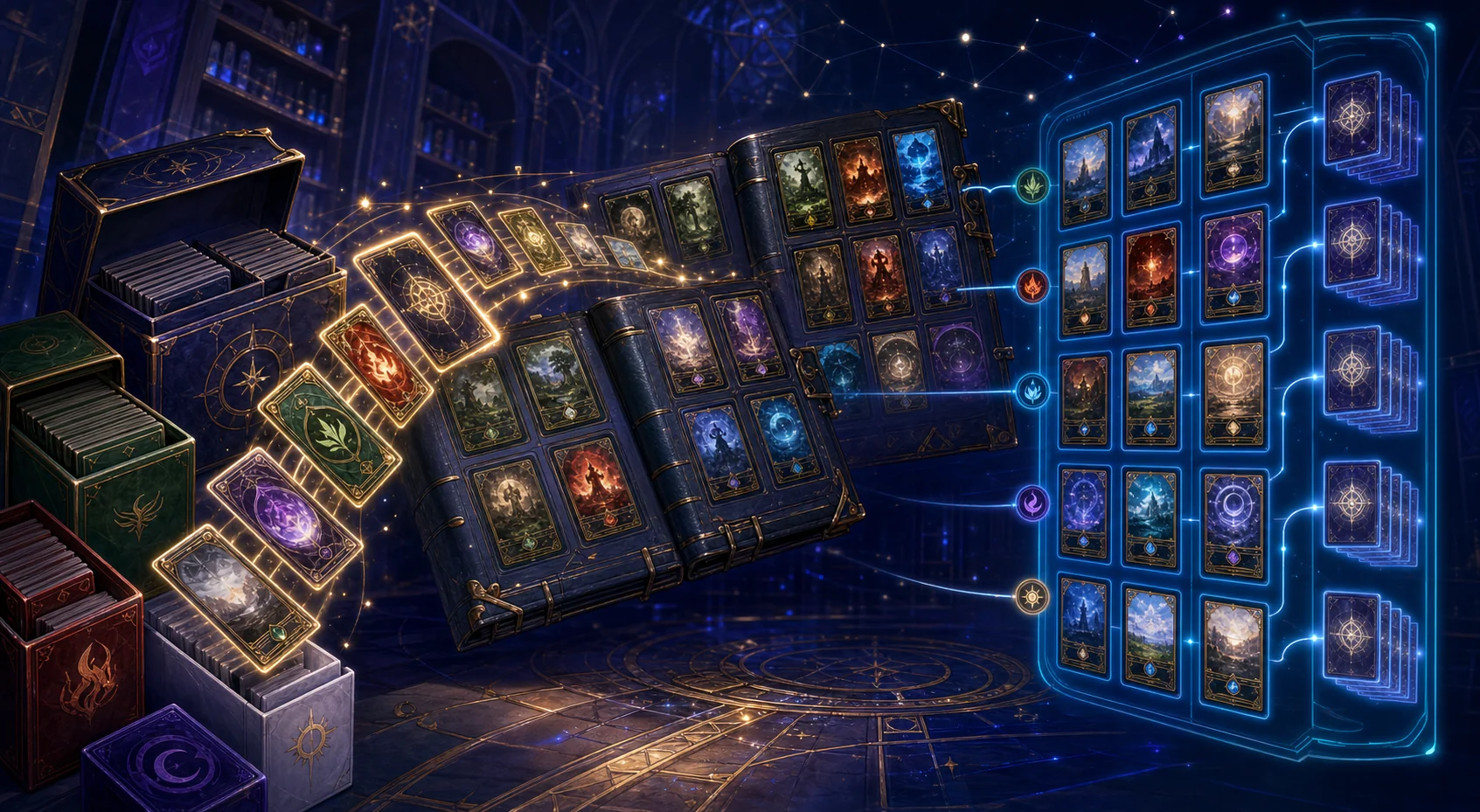
Mythscribe now connects trading card games, sets, cards, and individual printings in one collection-ready library spanning more than 116,000 cards.
Stories do not stop at the edge of a book, screen, or game. For millions of players, they also live in decks, binders, booster packs, local game stores, and the particular printing of a card that has travelled with them for years. Today, trading card games join the Mythscribe media library. This is a full new branch of
the catalogue rather than a single-game experiment. Mythscribe now connects each trading card game to its sets, each set to its cards, and each card to the individual printings collectors actually own, want, trade, and sell. From game title to exact printing The new catalogue follows a simple hierarchy: Game → Set →
Card → Printing Start with a game such as Magic: The Gathering , the Pokémon Trading Card Game , Disney Lorcana , or the Digimon Card Game . From there, you can explore its sets, open a set to see the cards inside it, and continue down to the exact printings of an individual card. That final step matters. Two copies of
the same card can come from different sets, use different artwork, have different collector numbers, or exist in different languages and finishes. Mythscribe keeps those editions connected to one card identity without flattening the differences that make a collection personal. A catalogue built across TCGs At launch,
Mythscribe holds: 11 trading card game catalogue homes 2,465 sets 116,156 canonical card identities 220,370 individual printings The launch catalogue includes game-level coverage for Magic: The Gathering , the Pokémon Trading Card Game , Pokémon's Japanese catalogue, Yu-Gi-Oh! , Digimon Card Game , Disney Lorcana , One
Piece Card Game , Star Wars: Unlimited , Riftbound , Flesh and Blood , and Gundam . Nine of those catalogues already include the set and card records made available by our free data sources. Flesh and Blood and Gundam currently have game pages ready for expansion, but their advertised set and card data is not exposed
reliably enough by the free source to import without guessing. We would rather show an honest gap than invent catalogue records. These totals are a launch snapshot, not a ceiling. New sets and printings will continue to enter the library as the public sources update and pass Mythscribe's import checks. New releases can
be discovered as they arrive The launch import gives Mythscribe a fast local catalogue, but card releases do not wait for a full database refresh. When you submit a search in the dedicated Cards tab, Mythscribe shows matching local cards immediately and also checks each available free TCG source within a strict time
and result budget. If a source knows about an exact card or printing that Mythscribe has not stored yet, the result enters a background import. The card is checked again by its provider identifier, connected to the correct game and set, and then kept in Mythscribe's local catalogue permanently. The page updates when
that import completes, so the next collector searching for the same release gets the local, faster result. Each source reports its own availability. A slow or unavailable provider does not hide local matches or results from the other TCG catalogues, and a similar-looking title is never enough to merge two card
identities. Cards have their own place in Browse A catalogue this large needs boundaries. Dropping hundreds of thousands of printings into an ordinary search for books, films, television, or video games would make Browse less useful for everyone. That is why the new Browse experience has two dedicated scopes: TCGs
returns game-level results, so a search for Magic: The Gathering finds the trading card game without mixing in similarly titled books, films, television programmes, or video games. Cards opens the dedicated card directory, where searches such as Black Lotus or Charizard can work at card scale. Cards also appear
naturally beneath their game and set pages. The result is a catalogue that can hold millions of possible collection entries without allowing them to overwhelm the rest of Mythscribe. Build the collection you actually have Signed-in collectors can track the exact printing rather than ticking off only the card name. A
collection entry can record: whether the card is owned , wanted , for trade , or for sale quantity and condition language and finish private notes Trading card collections are private by default. If you choose to make yours visible, it can become a social layer too: a way for other Mythscribe users to discover what you
collect, what you are looking for, and what you may be willing to trade. That combination is the heart of this addition. Mythscribe is not only building a searchable card database; it is creating a ladder from discovering a game to understanding its sets, finding a card, choosing a printing, and connecting that object
to a real person's collection. Free data, clear attribution The catalogue is built from free public TCG data sources, with provider mappings and image attribution retained on the relevant records. We do not import speculative price data, and we do not merge cards simply because their names look similar. Exact provider
identifiers and printing details take priority so that a missing value stays missing instead of becoming confidently wrong. That approach will sometimes leave a catalogue waiting for better public data. It also means the records that do appear can support the deeper collection tracking this medium deserves. Start
exploring Open Browse , choose TCGs to explore game catalogues, or choose Cards to search the dedicated card directory. When you find a printing you own, add it to your collection and make the new library your own. Books, films, television, video games—and now the decks and binders that carry stories into the room with
us. They belong together.
Open the interactive version on https://mythscribe.cloud/blog/trading-card-games-join-mythscribe-july-2026.