Mythscribe Mundus opens a library of life, lore and imagined worlds
Explore 4,978 researched profiles and a separate 110,000-record taxonomic catalogue across folklore, fictional worlds, natural history and cultures.
Mythscribe Mundus brings folklore, fictional creatures, natural history and peoples and cultures into one browsable research library. Its first public research edition is available at mundus.mythscribe.cloud, with 4,978 researched profiles alongside a separate catalogue of 110,000 taxonomic records. The invitation is
simple: start with something familiar, then follow your curiosity. A dragon can lead into a particular storytelling tradition. A fictional creature can lead back to its appearances and the world it belongs to. A fossil animal can become a starting point for exploring deep time. The library gives these subjects room to
be understood in their own contexts, while making it easier to move between them. Four collections to explore The library opens through four collections: Folklore & traditions, Fictional worlds, Natural history, and Peoples & cultures. You can search by name and aliases, browse the A–Z index, or narrow the collection
by region, group and kind. This makes it useful both for a quick lookup and for an afternoon spent following unfamiliar names. Folklore entries draw attention to particular sources and versions rather than treating every account as interchangeable. Fictional profiles span books, games, film and television, with source
and appearance information where it has been documented. Natural history covers selected living and extinct organisms, alongside a much larger taxonomic catalogue. Peoples & cultures has its own collection, keeping human communities and cultural context distinct from creature classification. Mundus also offers
relationship views and a journey through deep time. Scientific trees and narrative family trees serve different purposes: one concerns biological relationships, while the other follows relationships recorded in stories. Their accompanying notes help readers see what a diagram represents and where its interpretation
needs care. A source beside the story Profiles bring together descriptions, references, evidence notes and, where available, located passages or quotations. Sources & reading provides another route into the material. For readers interested in a creature's earliest accounts, a particular fictional version or the
evidence behind a scientific description, those references are a place to continue the investigation. Image records provide the available creator, source and licence information, with notes about the image’s role. A historical source page documents an account; a contextual photograph or cosplay interpretation serves a
different purpose from an exact depiction or official character artwork. Mundus identifies those differences instead of presenting every image as equivalent. Some entries also offer optional encyclopedia introductions. The current dataset contains 25,158 accepted taxonomic introductions attributed to Wikipedia
contributors, with revision and licence information. These are separate reference texts, not an additional 25,158 independently researched profiles, and they are not a substitute for checking the underlying evidence. An edition with visible limits The distinction between research profiles and catalogue records is
central to this launch. The 4,978 researched profiles form the editorial collection. The 110,000 taxonomic records provide broader catalogue access. A catalogue record should not be read as a finished, deeply researched article, and this release does not complete the project's ambition for at least 100,000 deeply
researched entries. Images and bibliographies remain incomplete. Many profiles still await a suitable documented image, and fictional appearance lists need further work across editions and adaptations. Regional coverage is uneven, and the presence of material from a place does not establish complete coverage of its
cultures or traditions. The Coverage & method page explains these limits and records the gaps. The researched profiles are original editorial summaries prepared with AI assistance and linked sources. They have not received independent specialist review. Readers can use the cited evidence to examine contested
interpretations and follow references beyond the summary. The interface offers dark and light reading themes, an A–Z route into the collection and layouts designed for desktop and smaller screens. Whether you arrive with a specific question or simply want to browse, explore Mythscribe Mundus and choose a subject that
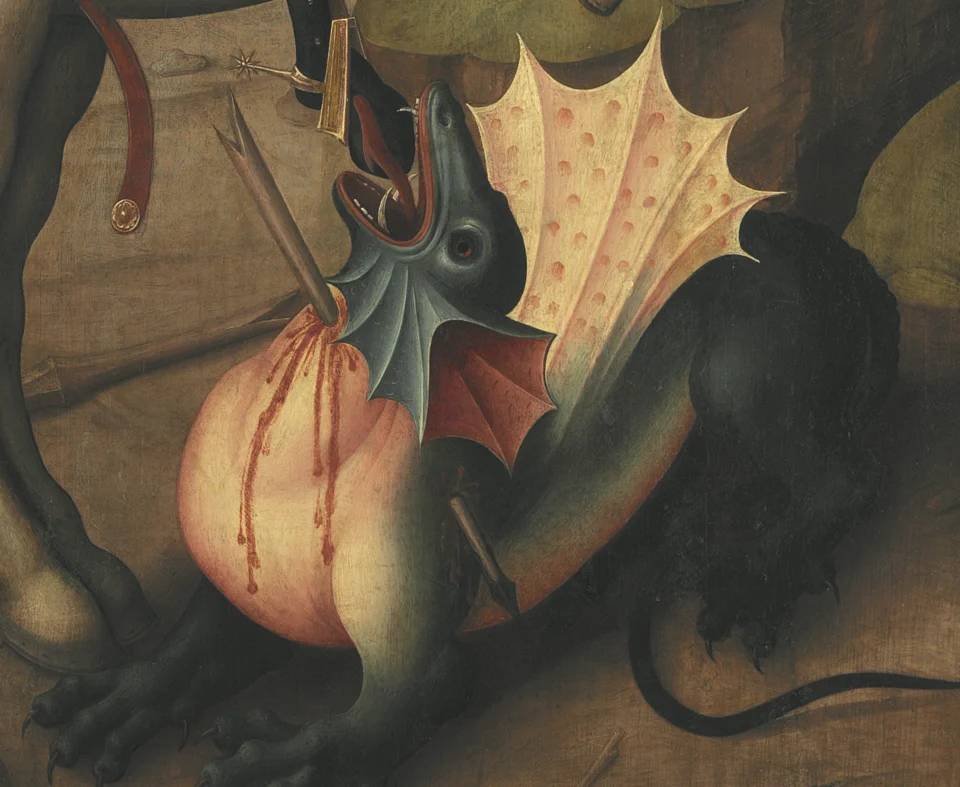
makes you want to read further. Headline image: dragon detail from Jan Baegert’s St Catherine / St George and the Dragon, recorded as public domain. Image source and attribution; public-domain status.
Open the interactive version on https://mythscribe.cloud/blog/mythscribe-mundus-life-lore-worlds-launch.